Featured

1848 – 1850 From Rappings at Hydesville to Mysterious Knockings In Rochester November 1849

Of course an event like Hydesville was bound to catch the press and as the news reached the nearest major city, Rochester, the newspapers began to report on it. Sadly the Rochester newspapers for the period have not yet been digitalised so we must rely on the repetition of their articles in other papers. The immediate responses were at best strange, this is reproduced from the Rochester Advertiser, probably from about the 25th April.

Then on the 13th May The Albany Evening Herald copied from The Rochester Democrat

Clearly the whole event was being dismissed as some kind of localised hysteria with no reality.

Then a later report appears, clearly linking the local story with the information from the EE Lewis Pamphlet. This is repeated in the 18th May 1848 Green Bay Advocate with the main story coming from the Rochester Advertiser.

As the article says, we await further developments. However, although articles such as these appeared widely in New York State and even managed to be reported throughout the United States and also in many other countries, the lack of any significant further developments meant that little more appeared over the next 18 months.

What then do we know about that period of time and what the Fox Sisters did, or whether there was any broader spread of the contact with Spirit?  What we have to rely upon are some newspaper articles, Samuel Byron Brittan and Andrew Jackson Davis’s Univercoelum and Spiritual Philosopher and the digitalised records of  Isaac & Amy Post, great friends of the Fox Family, who lived in Rochester, particularly their letters and correspondence now available on line ( http://rbsc.library.rochester.edu/ ). The Posts were committed Quakers, who had moved to the reformed sect, which was working within  the anti- lavery movement, helping with the underground railway which moved escaped slaves from the South to the free Northern States. Indeed the Post’s house was one of the stops on the Underground railway, with secret rooms where slaves were hidden until they could be moved on. They were also heavily involved in the new women’s rights movement.

We know that when Maggie and Kate arrived in Rochester a circle of friends formed around them to maintain the contact with Spirit, The inner core of this were involved in setting up the Rochester demonstration of mediumship in November 1849. Key participants in teh circle were the Posts, Eliab Capron and George Willets. They were regularly joined by other visitors many of whom came to the Post’s House to discuss the anti-slavery and female rights issues.

Indeed in one of these notable visitors, William Cooper Nell wrote a letter to Isaac Post, on the 11th August 1849, ( https://rbscpexhibits.lib.rochester.edu/viewer/3040 )  saying that ““The Mysterious Knockings” are exciting some interest in Boston
The Chronotype. has published 3 articles. I suppose from the Pen of E. W. Capron the first I send You by Mail, the last contain an account of what was manifested in Wesleys Family“. These are important articles, not just because so little was being written about the “mysterious noises”, but because they are the earliest writings by Eliab Capron on the subject.  However, as the only holdings are at The Library of Congres and no publication dates are mentioned it is very hard to get copies of them (albeit the Library of Congress is very helpful to researchers if they have details which enable them to find an article quickly and have helped me with copies of other articles in the past ).

I note from Nell’s writing that the last piece written was concerned the Wesley’s. It is interesting that, very quickly after the November Demonstration in early 1850,  Eliab Capron and Henry Barron published a book about the events in which the first 3 chapters cover background history, with the third written about the Wesley’s. It may be a logical jump to suggest those chapters contain the material he wrote about for the Chronotype ( E Capron & H Barron 1850 Explanation and History of the Mysterious Communion Withe Spirit https://ia902600.us.archive.org/14/items/explanationandh00caprgoog/explanationandh00caprgoog.pdf )
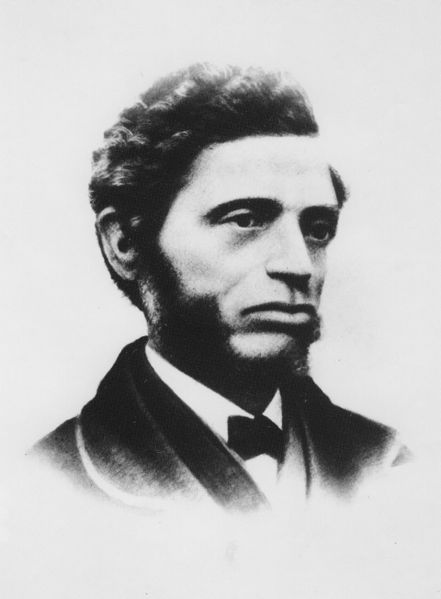
File:William Cooper Nell.jpg

William Cooper Nell (picture in the public domain)

We do know that the youngest sister Kate was sent to live with the family of Eliab Capron in Auburn hoping to stabilse her life in a normal environment. However all this did was to spread the rapping to Auburn. There are a few mentions of rapping elsewhere but by and large the story may have become just another historical curiosity without a further push by Spirit.

To get this information we also have to rely on some retrospective reporting in books, newspapers and articles. This reliance can be a problem because it is rather unreliable about the real facts, generally in regard to the many books about the Fox Family, but particularly when involving information provided by the elder sister Anne Leah, some 20 years older than the eldest of the two girls at Hydesville. To explain this, at Hydesville Margaretta was in her “fifteenth year” with Catharine 12 years old at that date (See Psypioneer http://www.iapsop.com/psypioneer/psypioneer_v4_n9_sep_2008.pdfRiddle of the records Lis Warwood). Anne Leah was not present at the cottage on the 31st March, she only arrived one month later, “by fast canal barge”, after she was became aware of the events that had occurred. Anne Leah’s involvement with the girls will, over time, be seen to become a problem. Indeed there is early evidence that she, herself, had no mediumship skills. Her reports will embellish the truth, adding things that never happened and progressively make her seem more important to Hydesville than she was. At the same time her age declines, by 1870, some 22 years after Hydesville, when she was actually 57, her age, officially in the census, was 40 and when she writes the almost fictional Missing Link in Modern Spiritualism in 1885 ( https://archive.org/details/missinglinkinmod00underich ) she describes the three sisters as all being “little more than small children”.

Of the other reports to be found, two of the key people involved were also close friends, one was George Willets , cousin to Isaac Post, the other Eliab Capron. Capron had come to know the Posts through their mutual involvement in the anti slavery and women’s rights movement. Indeed they were  present at the Seneca Falls Convention in 1848 that gave birth to the women’s rights movement (  http://www.nps.gov/wori/learn/historyculture/upload/_7-HRS-SectionI-10-18-08-printed-1EBA.pdf ) . This also shows the close association of the Posts with many leading figures around the abolition of slavery and womens rights. At times several of these figures, like Frederick Douglas, Susan Anthony & Elizabeth Stanton would join who would like Capron and Willets join the Posts and Fox Family in the evenings with Spirit that the two girls held in Rochester with both the friends and visitors over the period 1848 to 1849.

Theoretically this section should continue into 1850.  However, with the First Demonstration of Mediumship at Corinthian Hall in Rochester in November 1849 being such a major and vital event in the beginnings of Modern Spiritualism it needs its own post. Then 1850 is the launching pad for Modern Spiritualism with a huge amount of press coverage, across the United States and into Europe. Then the introduction of the term Spiritualist, in S.B Brittans explanatory lecture in New York in September 1850.

For reference http://iapsop.com/archive/materials/univercoelum/index.html

This incorporates The Spiritual Philosopher

Additional Reading

Philosophy of Modern Miracles S B Brittsn 1850 http://iapsop.com/ssoc/1850__dweller_in_the_temple___philosophy_of_modern_miracles.pdf

http://iapsop.com/archive/materials/shekinah/  SB Brittan

http://iapsop.com/archive/materials/buchanans_journal_of_man/
http://iapsop.com/archive/materials/spirit_messenger/

THE UNHAPPY MEDIUMS

March 31st 2023 will be the 175th anniversary of the beginnings of Modern Spiritualism.  While researching this historic event I came across an article, The Fox Sisters: Some Unsolved Problems, published June 24, 1943, in ‘Light’, the weekly journal of Spiritualism.

The article raised several issues. First, that there appeared to be no properly researched history of the Fox family. Attempts to establish where the Fox family had come from, or where the girls were born, had apparently failed. This seemed a great failure given their importance in initiating Spirit Communication. Second, there was uncertainty about the ages of the girls at the time of the events at Hydesville, New York County. Margaretta may have been 15, 14, 13 or 12, and Kate 12, 11, or 9. 

The third issue of concern was whether there was any validity to Maggie and Kate’s confessions that what had occurred at Hydesville and afterwards, had “been humbuggery from first to last” and “an absolute falsehood”. It was noted, these admissions led to the publication in 1888 of “A Death Blow to Spiritualism” by Reuben Briggs Davenport. While arguing that Spiritualism did not stand or fall on the work of the Fox Sisters, the writer thought that a true record would be of benefit.

When examining the importance of the Fox Sisters to the Spiritualist movement, there is little doubt that it was their work in the first three years that helped fuel the interest of many, as the reports of events in Rochester and then New York spread through the country. The interest taken in the girls by Horace Greeley, editor of the New York Tribune, meant many people attended séances, including those in a position of influence, who left impressed by the information they had received. After the Fox sisters left New York, the New York Tribune of September 30th 1850 carried a report praising “their integrity and good faith”.

Although the Fox sisters were friendly with many who became the founders of the Spiritualist movement, Maggie and Kate largely remained distanced from the actual events that helped promote its development. Indeed, the personal circumstances of each of the sisters were to see them take very different pathways in life, and ultimately result in the breakdown of their relationship with the family, especially with Ann Leah, their eldest sister, and with Spiritualism.

In 1849, Kate Fox spent time in the home of Eliab Wilkinson Capron in Auburn and did not take part in the first public demonstration of mediumship, with its subsequent investigation, at Rochester in November of that year. In 1851, Greeley persuaded the Fox’s to let Kate go to school, to gain a proper education. She spent some months at his residence, until the living conditions with Mrs. Greeley, became intolerable.

On returning home Kate resumed holding séances and doing readings. Perhaps, not surprisingly, given the way her life developed, Kate was often described as a person who seldom embraced life joyously. As far as possible she worked away from her sister Ann Leah Fox. In 1852 Kate was to be found in New York working giving readings at the newly founded organisation the Society for the Diffusion of Spiritualist Knowledge. This association lasted two years and published its own newspaper the Christian Spiritualist which can be found on line at http://www.iapsop.com/archive/materials/christian_spiritualist/

Towards the end of 1852, Maggie Fox met Elisha Kane, an Arctic Explorer. He became enamored with her but not with Spiritualism which he felt was an improper way of life. Throughout 1853 he worked to convince her that if she was to marry him she needed to give up the Spirits and take up schooling.  Finally, in the latter half of 1853, she stopped working as a medium, and moving away from her family, commenced a period of private schooling, arranged by Kane.

Maggie claimed that she and Elisha Kane were married in secret in October 1856. Despite moving back with her family while he was away on his travels, to honour his wishes, she did not return to spirit work. Sadly, the 37 year old Kane died in Havana on Feb 16, 1857. After his passing, Kane’s family refused to provide for Maggie denying her alleged marriage to their son. Despite financial hardship, Maggie did not return to spirit work, but spent years fighting Kane’s family over money she believed Kane had intended she receive. During this period, with its levels of distress, bouts of anger and depression, Maggie began to suffer the effects of alcoholism, a problem that continued throughout the rest of her life. Kate, too, would soon suffer from the same condition.

In November 1858 Ann Leah married the wealthy Spiritualist, Daniel Underhill, entering a very different, more affluent lifestyle with many influential friends. This allowed her to remain more intimately involved with Spiritualism. Emma Hardinge Britten’s auto-biography, published in 1900, after her death, highlights Ann Leah’s friendship with Robert Dale Owen and Emma. Indeed, this book states that it was at a séance with Ann Leah and Robert Dale Owen, around 1862, that Robert Owen came through to Emma impressing her with the Ten Spiritual Laws and Ten Spiritual Commandments, which were included in the first Lyceum Manual.

In December 1864, friends of Maggie and Kate, discovered the state of their dependence upon alcohol and it was arranged that the sisters go into the treatment centre of a George Taylor, with the costs to be paid for by Ann Leah and Daniel Underhill. However, the death of their father John Fox on Jan 5th 1865, delayed matters. Subsequently Katy agreed to go ahead with treatment, but Maggie refused help.

On August 3rd 1865, Mrs Fox passed away, once again leaving Maggie and Kate to grieve. Maggie, disillusioned with the continued mistreatment of her by Kane’s family released The Love Life of Doctor Kane, a book based on his letters to her. If Maggie had hoped the book would end her financial worries she was sadly disappointed and was finally driven back to working as a medium. Throughout this period her relationship with Ann Leah continued to deteriorate. They were rarely on speaking terms, and the rift between them would ultimately prove permanent.

Despite receiving treatment, Kate was too easily drawn back to alcohol by her sister, so a subterfuge was worked out, whereby she was invited to London. The trip proved successful, and her mediumship moved to a new level, proving successful under strict test conditions, particularly for Sir William Crookes. On a personal level, she also benefitted, marrying the Barrister Henry Jencken on 14th December 1872, and forming a very happy partnership which saw the birth of two children. (you can find the research by Crookes here just search the pdf for Fox http://chem125-oyc.webspace.yale.edu/125/history99/8Occult/CrookesPsychic.pdf )

Sadly on November 26th 1881, Jencken died leaving his affairs in a state that made it difficult for Kate. She finally managed her return to New York in 1885.  This coincided with the release of Ann Leah’s book, The Missing Link in Spiritualism, which added to the disharmony between the sisters. Sadly, the return also saw a progressive relapse into alcoholism for Maggie and Katie.

It is these disparate events that have led to a fractured account of the real history of the Fox Family. Many accounts have softened the truth, others have changed it in various ways. Probably, given the sad way the lives of Katie and Margaret played out, it is not surprising their stories have been inadequately reported.

Particularly relevant was the way that Ann Leah Fox Underhill embellished her accounts of Spiritualism’s beginnings. We see this, both in her 1885 book, and in the story she passed on to Dale Owen, recorded in Footfalls on the Boundary of Another World,published in 1860. In these books, the two young girls ages change, and it is Kate, not Margaret, who asks “Mr. Split-foot” to do as I do. In Mrs. Fox’s initial account of events recorded just 4 days after the fateful night communication with the spirit world began, and published a few weeks later by E. E. Lewis in the pamphlet A Report of the Mysterious Noises, Heard in the House of Mr. John D. Fox, no mention is made of the phrase ‘Mr. Split-foot, Margaret Fox’s older daughter, Maggie, is described as having said ‘do as I do,’ and the girls are described as being in their 15th year, and about 12.

How, and why, the ‘Mr. Split-foot’ aspect of the story came to be incorporated into later records is still unclear. That the ages of girls as stated by Mrs. Fox in April 1848 should subsequently become so uncertain, can, however, largely be attributed to the deliberate  obscuration of the truth on the part of Maggie, Kate, and Ann Leah, though why they did so remains unclear. A copy of the Lewis Report, can be found at psypioneer.iapsop.com/psypioneer_v1_n12_apr_2005.pdf and research into the ages of the Fox sisters, by Lis Warwood, at http://psypioneer.iapsop.com/psypioneer_v5_n9_sep_2009.pdf

As for Maggie and Kate’s confessions, at the time both sisters were in a sorry state, short of money, and drinking excessively again. It is almost certain that Maggie received money to confess. An Oct 12 1888, Chicago Tribune article revealed Kate was furious with Ann Leah and her Spiritualist friends. She believed they had her two children taken away by the Society for the Prevention of Cruelty to Children, because her drinking made her incapable of looking after them. It is no wonder that she then turned upon her perceived enemies.

Subsequently, Maggie recanted her confession, indeed, when she died on March 9th 1893, the records show that raps were occurring all around her bedchamber. Kate had died on July 2nd 1892. Largely shunned and ignored by the Spiritualist movement, their unhappy and troubled lives had finally come to an end.

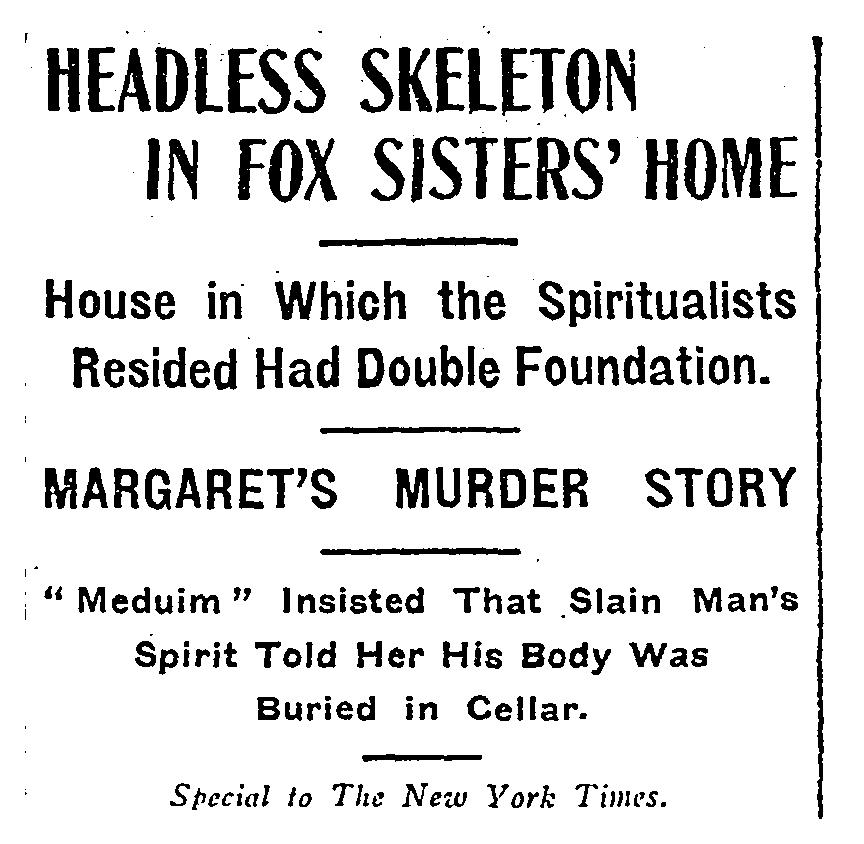
Oh yes, on November 24th, 1904, The New York Times reported the finding of a headless skeleton in the foundations of the Fox Cottage, thus apparently corroborating the story of the rappings, However, who the pedlar was, what happened to his bones, and what else, if anything was found to substantiate his existence, is another story.

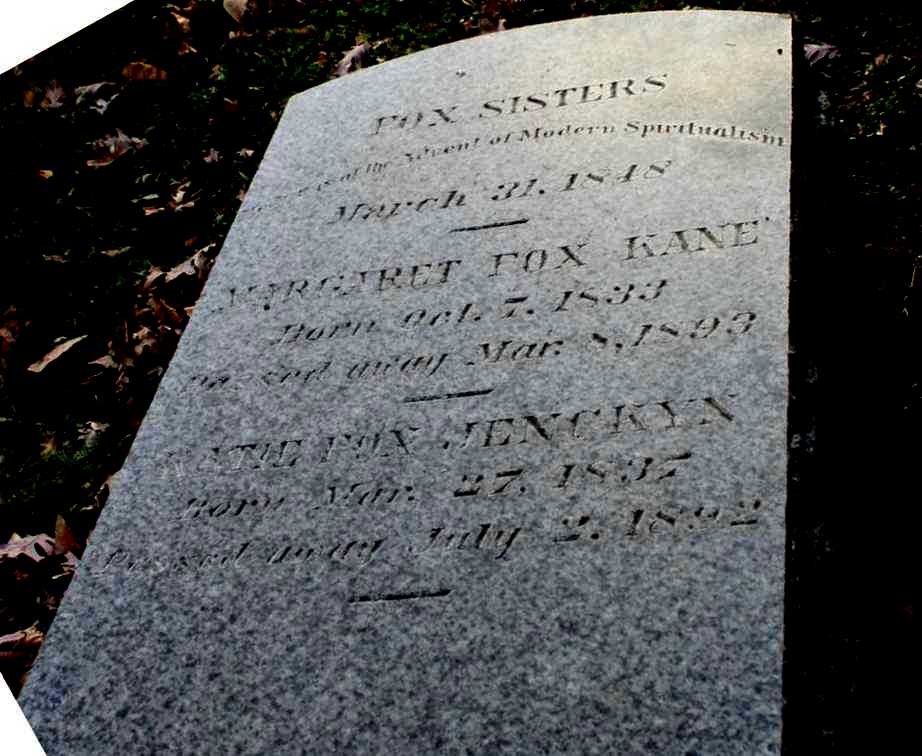
As a final point the headstone shown below, paid for by Margaretta’s close friend Titus Merritt, he obtained the birth dates from Margaretta just before her death. Naturally these matched the ages that were given in the EE Lewis report at the time of the Hydesville rapping’s.  These were also the dates that their Mother repeated on several occasions. So despite her, and Kate’s lifetime of becoming younger at each census Margaretta resumed her correct age just before she passed to Spirit.

Sadly although monies were collected to restore the old headstone, a new one was effectively produced, using different birth dates. These accorded with the view of the person who arranged the renovation who felt she had got different information from relatives. So, visitors to the headstone will never know about the change because it was never commented upon at the time. To me the original information was correct as the family would have become confused by the numerous age changes the sisters insisted upon over life.I suspect the answer may lie in the letters exchanged between Kate and Margaretta and Amy Post but they do not appear in those digitised so far.

©Lis & Jim Warwood

A Short Overview of Spiritualism’s Development & Principles

Part of working on a platform is educative, this is a talk I gave back in July 2012 which has been edited to add some source material and work alone for the forum. It has also been expanded to include new knowledge and ideas that have arrived over time.

The original foundation of Spiritualism was that Survival of the individual was proven beyond that which we call death. This was first proven on March 31st 1848 when the spirit of a murdered pedlar communicated with firstly the Fox family, or more correctly with the parents and two youngest children Kate and Maggie, then with a group of neighbours headed by a Mr Duesler. Most vital to this is that the most important communications were with the neighbours over some days AFTER the Margaretta Katie and their mother had left to go and stay at their Brothers house. Indeed Mr Duesler’s part was pivotal in the actual communication.

A unique event because 11 days later a lawyer, turned journalist, took witness statements from those present. These were gathered together in a booklet which was published by the end of April 1848, a pamphlet called “A REPORT OF THE MYSTERIOUS NOISES, HEARD IN THE HOUSE OF MR. JOHN D. FOX”,. You can find this here at  Psypioneer http://www.iapsop.com/psypioneer/psypioneer_v1_n12_apr_2005.pdf. Critically this and other research has enabled us to clear up some errors which have been repeated through the popular versions of our history.


These were errors were primarily caused by the embellishments made by Anne Leah Fox Fish Brown Underhill, the eldest sister, who was not present at Hydesville in her reminiscences’ about the event. First given to Robert Dale Owen and published in 1859 in his book Footfalls on The Boundary of Another World (  https://archive.org/details/foot00fallsonboundowenrich ). These included the youngest sister asking the Spirit here Mr Splitfoot, do as I do, when there was no mention of Splitfoot and it was the eldest sister.

She repeated these items, among other embellishments and changes in the ages of the daughter in her own 1885 book “The Missing Link in Spiritualism” ( https://archive.org/details/missinglinkinmod00underich ) . Sadly it is these versions which have been picked up and used widely as the source of our history. More can be found out about this issue here http://www.iapsop.com/psypioneer/psypioneer_v5_n9_sep_2009.pdf
and about their ages in Riddle of the records here http://www.iapsop.com/psypioneer/psypioneer_v4_n9_sep_2008.pdf . This can be read on the forum here if the psypioneer link is down https://www.spiritualismlink.com/t295-the-fox-sisters-riddle-of-the-records. The changes to ages, Leah losing 20 years of age between 1848 and 1885 and each of the girls getting younger each census is another cause of dispute.

The impact of this confusion can be seen in one recent act. When the Fox Sisters headstone was renovated the dates of their births were altered as part of the work, because the organiser felt she had information from the family, from contacts provided to her by Lis and I, which changed those dates. This even though an old friend of Margaretta had paid for the headstones.

The friend, Titus Merritt, obtained the actual dates from Margaretta just before her death, additionally the ages and dates were a constant feature of all of their Mothers statements (whereas the girls age changed at each census, reducing their ages, which would have then impacted upon the later families true knowledge as their birth certificates were lost in Canada. Add to this that Paul Gaunt, then Psypioneer Editor, also the Archivist of the Arthur Findlay College library and the SNU’s official historian, described the research by Lis in Riddle of the Records as the definitive record after meticulous research. So future generations, who visit the headstone, will be presented not with the original one renovated, but a new version of the stone.

Returning to the first of those two Psypioneer articles, that I gave links for in the paragraph before t last, they also mentions the issue of the pedlar’s name, which is always quoted as Rosna. However, it is almost certain this could be Rasme, as I discovered during extensive newspaper research from 1848 to 1853 you can see the details in my blog here https://spiritualistblog.wordpress.com/2012/08/21/the-hydesville-peddler/ .
On the other hand the EE Lewis report only has one reference to the name being sought, in the statement by Mr Duesler , who asked the question late on the first night when Mrs Fox and the sisters had left the cottage. His precise statement was I commenced with A, and asked if that was the initial of its first name? there was no rapping. When I came to C, the rapping was heard, and at no other letter in the alphabet. I then asked in the same way,” in regard to the initial of its sir-name; and when I asked if it was B? the rapping commenced. We then tried all the other letters, but could get no answer by the usual rapping. I then asked if we could find out the whole name by reading over all the letters of the alphabet? and there was no rapping.”. We only have the initials CB which in some way became Charles Rosna or Rasme.

In Psypioneer Paul Gaunt reviews this and the fact the name was not seen as important initially ( http://psypioneer.iapsop.com/psypioneer_v8_n1_jan_2012.pdf ) . It may be to much emphasis has been placed upon creating a name for the pedlar and placing the Fox Sisters as the people who received this information. In doing so the sheer importance of the greater communication occurring between the neighbours and the Spirit, while the girls were not present, is missed. It is that fact that makes any charges the girls committed fraud at Hydesville invalid because they did not participate in the communication for very long.

After the Hydesville events the Fox family never moved back into the Cottage. At first they lived in the house of their son David before the eldest sister Anne Leah Fox Fish arrived and took Kate back to Rochester with her, the Mother and Margaret followed them soon afterwards. In Rochester the rapping’s continued with the Fox sisters gathering a group of close supporters, who believed in the truth of communication with Spirit.

Their closest supporters in Rochester, friends from before the Hydesville days, were Isaac and Amy Post, two Quakers they had known in the past and some others who were drawn in by the Hydesville events, or their relationships to the Post’s. Isaac and Amy, along with R. D. Jones, John E. Robinson and George Willets, were among the original group of five people who first met regularly at the Fox’s’ house to investigate the source of the “Rochester Rappings” ( https://rbscp.lib.rochester.edu/exhibits/show/post-family-papers/the-posts. 

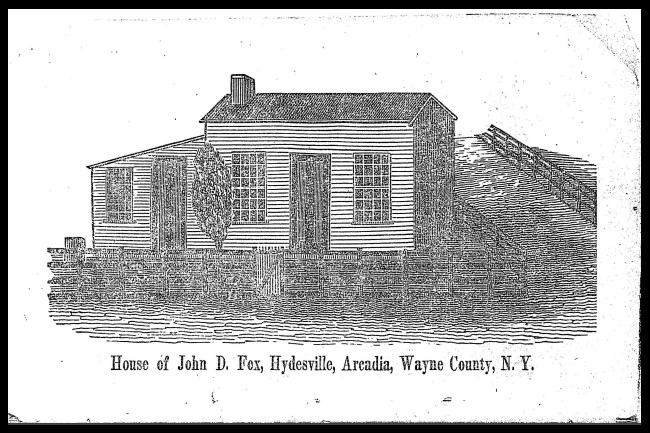
Image of the Cottage on P2 Of the EE Lewis report

George Willets was a cousin of Isaac Post, and they were joined by Eliab Capron. Indeed Kate was to move to Auburn to stay with the Capron family in 1849, in an attempt to stabilise her young life away from these activities. This step was to be in vain because rapping’s also then started in Auburn soon after she arrived there, it may appear, from her personal history, that Katie was, in fact, the most powerful medium of the two Fox sisters.

The circle they formed was regularly joined by other people and, because the Posts were heavily involved in the anti-slavery movement (their house was one of the stops on the Underground Railway moving escaping slaves to the north and safety https://education.nationalgeographic.org/resource/underground-railroad ) and also with the Burgeoning Women’s Rights Movement, this included many of the leaders of those groups.

At this time there was no deeper philosophical interpretation put upon this communication by a Spirit. It was purely proof that all of us survived beyond death with our individual memories and personality. This was reconfirmed by subsequent communication both with the Fox Family and other, as they were called, media. However, although these discoveries attracted the widespread attention of a range of people from different but predominantly Christian, religious denominations, it was likely to have become one of history’s curiosities had Spirit not decided to take a decisive step.

By November 1849 only Maggie, Anne Leah and the mother were in Rochester and they were holding regular circles to communicate with Spirit. At this stage Spirit made a very important request, that they make a public demonstration of their mediumship in Rochester challenging the attendees to make a full investigation of their claims. A letter Marc Demarest came upon is very enlightening, written by George Willets in 1850, it confirmed that the only medium present at that time was Maggie; Leah had no mediumship skills whatsoever. indeed when the SDSK was formed (see below) Leah was just described as a Speaker, Katie as a medium, Maggie true to her promise to Elisha Kent Kane was not working . ( good on Marc for finding it first I came upon it the day his blog appearedhttp://ehbritten.blogspot.com.au/2014/09/spirit-conductors-letter-from-george.html )

This was arranged for the largest hall in Rochester, the newly opened Cleveland Hall, the event was well advertised and on the evening of the 14th November the hall was packed to hear firstly a lecture on the history of the “mysterious noises” then the demonstration with raps sounding resoundingly from every section of the Hall. A committee of notable citizens was formed to investigate the phenomena and report back on the next night. This went on for 3 days with each new committee finding no fraud or apparent reason for the knockings, except potentially Spirit communication. ( https://www.spiritualismlink.com/t311-1849-the-corinthian-hall-investigations-of-the-fox-sisters ) and of course the original book concerning the events at Rochester By Eliab Capron and Henry Barron in 1850 https://archive.org/details/cu31924008149118

The events were widely reported and led to the Fox sisters setting off touring various cities, arriving in mid-1850 at Barnum’s Hotel New York City (never to be confused with the entirely separate P T Barnum’s circus). Here they conducted sittings and séances which convinced the citizens that Spirit was communicating. Their most notable supporter was Horace Greeley the editor of the New York Tribune which reported widely on the events in a manner which helped spread awareness of their integrity and the fact of communication with Spirit.

It was these events which first saw the term Spiritualists used for those who believed in communication from Spirit. For them communication was a truth. Even then there was no deep philosophy propounded by the Spirits. It was enough that they made us aware of their presence. That life continued, for everyone, good and bad, rich, or poor, regardless of race or religion. Indeed 1850 saw the first address on Spiritualism, by Samuel Byron Brittan ( https://www.spiritualismlink.com/t110-the-first-lecture-explanatory-of-spiritual-philosophy-1850 )

Even though the events at Rochester drew many more adherents to this new belief, including many very influential citizens, these supporters still had their own basis of belief. The Posts were Quakers, Samuel Byron Brittan one of the foremost proponents of the fledgling movement was a Unitarian minister who had once been a follower of Andrew Jackson Davis. Davis himself had been a follower of the ideas of Swedenborg’s New Church but had formulated his own Harmonial Philosophy Association.

Despite the gathering of so many people from different backgrounds there was no overall thrust to see Spiritualism become a new religion. Indeed, when a new organisation was formed in Boston in 1854, the New England Spiritualists’ Association, it published its list of officers, constitution and an address concerning Spiritualism. This include an important statement;

“Our creed is simple.  Spirits do communicate with man—that is the creed.  The legitimate consequences of belief in that single fact, are all that can be chargeable upon Spiritualism.  All else that Spiritualists may believe and do, belongs to them as individuals, and not necessarily as Spiritualists.  We seem to be saying but little; yet it may be no small matter to utter unitedly the five simply words—Spirits do communicate with man.” (the full document is here https://archive.org/details/constitutionbyla01newe )

This simple phrase re affirmed the original concept of the communications at Hydesville and Rochester. Spirit had affirmed our continued existence and their ability to communicate with us no more and no less.

An alternative approach was followed by the Society for the Diffusion of Spiritual Knowledge also founded in 1854 with a definite philosophy and leaning towards Christian Spiritualism. Kate Fox worked as a medium at their headquarters, Emma Hardinge Britten was choir master, Leah was just described as a Speaker confirming her lack of mediumship skills, Maggie, keeping to her promise to Elisha Kent Kane, was not working (indeed she was living at the house of Horace Greeley editor of the New York Tribune.  Details can be found here – http://spirithistory.iapsop.com/1854_society_for_diffusion_of_spiritual_knowledge.html and their weekly newsletter The Christian Spiritualist here http://www.iapsop.com/archive/materials/christian_spiritualist/ .

However, by this stage Spiritualism was attracting great attention both in America and Europe. It drew many adherents, with numbers rapidly rising over the million. Books, magazines and newspapers were appearing with great rapidity, and these would reflect a wide range of views. (just look at the listing of the archive at IAPSOP http://iapsop.com/archive/materials/  what a wonderful job that team has made in recovering so much history for us that they freely share).

It became clear that there were many viewpoints about what Spiritualism meant. There was a group, including Samuel Byron Brittan, a Supreme Court Judge, John Edmonds, and Andrew Jackson Davis who saw it as an entirely new revelation. Although each may have differences in their view of what should or should not be included in the creed they saw it as replacing and sweeping away the old for a new rationally based religion.

Other Spiritualist’s saw it as a new element of Christianity, a revelation that was consistent with Biblical teachings and could be incorporated into their own form of Christian Worship.

A further group, as indicated by the New England Spiritualists, clearly saw it as new information which could be included in any religion. This was not something which swept away old religious belief but the new revelation, life continued beyond death, could be shared with everyone. Indeed, it was a simple, provable truth which should be open to every living person on Earth. Currently there are atheists who have accepted this proof and believe in survival even if not God, a visit to the Campaign for Philosophical Freedom run by Michael Roll will give a flavour of their thinking.

.


I have left out another element, there were many people in Victorian times who were students of the esoteric and the occult. It was the era of Ghost Stories and occult societies. To them the continuation of life beyond death was an addition to those esoteric studies. Many of these people mingled freely with the other Spiritualists. Madam Blavatsky was to lead the first split off from Spiritualism to form a society more representative with these ideas The Theosophical Society (Emma Hardinge Britten was formerly a friend of Blavatsky and was a member of the founding committee of the Theosophists). However, on many occasions members of this and other societies often remained in the Spiritualist movement (Emma is equally revered in the Hermetic Brotherhood of Light https://adepts.light.org/2020/10/09/ancestral-chart-explained/).

Andrew Jackson Davis spoke about these three strands in a 30th anniversary address in 1878 (https://www.spiritualismlink.com/t656-the-three-strands-of-spiritualism-andrew-jackson-davis? )

However Spiritualism, through its publications did create a vvery influential version of its Principles which clearly become a part of Emma Hardinge Brittend fianl version.

By 1857 a new publication appeared which was the first of a series of The Annual Spiritualist Register, about what Spiritualism is, its publications, mediums, speakers, and the organisations. Plus the numbers of Spiritualists registered to those bodies. Fascinating as thisis it also gave a view of the principles https://archive.org/details/spiritualist-register-1857

By 1861 this had been amended to include the principles laid dowm by AE Newton, who also defined what Spiritualism is http://iapsop.com/spirithistory/what_is_spiritualism.html

These principles were then included in the 1861 edition of the Annual Spirtualist Register https://archive.org/download/annual-spiritualist-register-1861/Annual_Spiritualist_Register_1861.pdf . This version then spread into England being included in the Seed Corn Tracts published by Medium and Daybreak in 1872 http://iapsop.com/ssoc/1872__various___seed_corn_tracts_on_spiritualism____1-7.pdf


It is against this varied backdrop that Spiritualism was to develop. The very first attempt at a national association, in the USA, tried to remain focused upon the phenomena and the contact from Spirit. Founded in 1864 it ran until a fateful annual general meeting in 1872. As an organisation it never adopted principles to define what Spiritualism was, but attempted to guide the development of the movement. In 1872 it finally split because its then President Victoria Woodhull propounded a direction incorporating socialist principles (she was the first person to publish an American version of the Communist Manifesto), women’s rights and free love.


It was Victoria Woodhull’s involvement with Spiritualism , the direction she was taking and her determination to stand as President (although as a woman not allowed by the constitution to do so) in an election, where Horace Greeley was another candidate, which caused him to withdraw his support from the Spiritualist movement.

It would not be until the 1890’s that Spiritualism would again seek to formally organise on a National basis in both the UK and the USA, although some looser associations formed in both countries.

The delay was because of the fundamental differences in the position of the varying groups of Spiritualists. However, by 1890 it was clear that the traditional religious groups were not going to revise their theologies to incorporate the truth of life after death that Spiritualism’s mediums were proving because, by and large, they considered this as an evil act reflecting the influences of Satan and evil Spirits.

Spiritualism was suffering from persecution and found itself unable to present a concerted rebuttal of the views that were opposing them. In America they organised in 1893, forming what was to become the National Spiritualist Association of Churches. Even long-term opponents of organisation, like the famous medium Cora Scott Richmond, now spoke entirely in favour of organisation. Very soon after formation they adopted their first declaration of principles and registered formerly as a religion.( http://iapsop.com/spirithistory/1893_national_delegate_convention_of_spiritualists.html )

In the UK the formation of the British National Spiritualist Association in 1873 set in train the gradual evolvement to the Spiritualist National Union of Great Britain in 1901. This adopted the 7 principles which had progressively evolved through the work of Emma Hardinge Britten over several decades. They began to be mentioned by her, in their full form, in 1888 and were most famously recorded at an address laying the foundation stone for Oldham Spiritual Temple (see p 13 http://www.snu.org.uk/documents/pdf/SNU%20PIONEER%2001_01.pdf). The adoption of a formal statement of belief was a vital step in registering as a Religion and gaining charitable status.

More can be found about the principles in several places; https://www.spiritualismlink.com/t131-the-seven-principles-a-discussion-on-their-creation , http://www.iapsop.com/psypioneer/psypioneer_v2_n5_may_2006.pdf FoundedbyLesliePrice.pdf and http://www.iapsop.com/psypioneer/psypioneer_v6_n9_sep_2010.pdf

Even then the new organisations were the home of elements that had very different views about what Spiritualism was. The schism with a Christian viewpoint was to see separate organisations formed to represent the concepts of Christian Spiritualism. In the UK this occurred after a move by Sir Arthur Conan Doyle, a committed Spiritualist, to add an 8th Principle “The Christ Principle” to the SNU’s 7, failed by a narrow margin. http://www.iapsop.com/psypioneer/psypioneer_v1_n7_nov_2004.pdf . A similar path was taken in the USA as Christian Spiritualist formed their own organisations, when the proposal to adopt a Christian Base for the National Spiritualist Association of Churches (NSAC) was rejected in convention.

Interestingly the removal of all non-white members of the NSAC, on segregation grounds, in 1922, also saw the formation of a rather dynamic new group of Churches in the USA often embracing a broad range of belief systems. A brief review can be found here http://www.readersandrootworkers.org/wiki/Category:Working_Within_the_Spiritualist_Tradition. This is not a bad version of the variations in Spiritualism either. The 1922 events and the effect on those forced from the NSAC and the way their Churches developed is something I may well write about separately because it intrigues me. It also highlights the rather uncomfortable relationship between our principles and the reality of our personal prejudices, or our toleration, so we fall within the norms of society, even when our moral position tells us it is wrong. The pioneering Spiritualists, who were often heavily involved in the equality and anti-slavery movement must, in Spirit, have been horrified.

In the USA a further rift was to occur when one group rejected the refusal to allow any teachings about reincarnation. This is the policy of not just the NSAC but also the SNU’s… The lack of proof positive for reincarnation and past lives leaving the organisations to remain neutral on these areas. It also focuses Spiritualism on a life review after returning to Spirit and a rejection of the concept behind Karma.

Interestingly one of the only references to this split is https://web.archive.org/web/20141002032315/http://spiritualallianceusa.org:80/About.html , this organisation, whilst retaining the principles of the NSAC, accepted the precept of reincarnation also remaining a non-Christian approach.

What we can see is that Spiritualism is now a Religion. It is still a matter of conjecture about whether it was meant to be one, or just a philosophy of Spirit open to all. The problem with Religions is they tend to develop rules and theology. Spiritualism never had Ministers until the NSAC was formed, indeed in the UK the SNU only introduced this status several decades after its foundation. Spiritualism could easily be seen as many different religions’. However, my position about Modern Spiritualism is within the arena of the SNU and NSAC principles. I still have issues about the principle of a Ministry which creates visions of people who have control over the philosophy.

Conceptually organisations can be of great benefit to any movement. They can help to educate, promote, and form reliable standards. If they are run correctly, they can encourage research, investigation and foster informed growth in the knowledge base of the movement. I suspect that it was this ideal that was behind the pioneers of Spiritualism, both before organisation and immediately afterwards, when the movement encompassed many different views.

Personally I see Spiritualism as a philosophy, the words we have received from Spirit can help us guide our lives. The teachings can lead us to endeavour to raise our standards of behaviour and try to be of service both to others and Spirit. Finally, I see it as a religion because I believe in one unprovable being God, The Fatherhood of God but I look at this in a much broader way because in some way we are a part of the creator with a spark of that Spirit within every person, animal, and object on this planet. However creation continues, new star systems and planets are being formed far away from us, on the far side of the universe. We are not God’s only concern, indeed that creator is still busy building our expanding universe. So busy that perhaps mankind is being left to create our own heaven or hell, on our planet and the Spirits of those who have gone before try to give us guidance to enable life to continue. It would explain much about the nature of events, manmade and natural, that seem to reflect little about the presence of a loving, caring God. Devoted just to our one tiny spec of dust in the vastness of a universe filled with billions or trillions of planets and stars.


Jim 8/7/2012 edited on 29/4/2014 and 3/12/23
© Jim & Lis Warwood

Since this time psypioneer revisited this story
http://www.iapsop.com/psypioneer/psypioneer_v8_n1_jan_2012.pdf

After my discovery that George Willets released the name Charles Rasme to the press in 1849, shortly before the Corinthian Hall demonstration Marc Demarest came upon a very enlightening letter, written by Willets in 1850 http://ehbritten.blogspot.com.au/2014/09/spirit-conductors-letter-from-george.html

Why do Spiritualists say Modern Spiritualism began at Hydesville 31st March 1848

This is an important question to consider, especially as some people have always tried (even from the earliest days of the new movement) to legitimise Spiritualism by linking it with Christian Beliefs. In addition there are many books and newspaper articles which try to justify the 1848 events, together with the subsequent contacts with Spirit, by reference to the Biblical Prophecies and Miracles.

However, there is a basic difference to other biblical or prophetic events which is really quite simple to explain. At Hydesville the Discarnate Spirit of an ordinary person communicated with normal people living ordinary lives in the small cottage in a remote hamlet in New York State where the Fox family lived. This was not some prophetic dispensation direct from either God or one of his exalted messengers to a “chosen one,” as some form of new divine revelation.

Indeed New York State had already seen several of these prophetic revelations, to chosen people, in the earlier years of the nineteenth century. The first of these led to the creation of the Mormon Church.  The second, predicting an Ascension event where Jesus Christ would come and rescue all of his chosen people before the earth was destroyed, was given to Andrew Miller in 1831. He founded the Millerite Church which spread to both Australia and Europe, carrying the message of Christ’s return sometime between March 21, 1843 and March 21, 1844 to millions of people. After the event failed to occur the church continued but became the Seventh Day Adventists.

However, saying this was a new style of communication is not to deny that there had been previous attempts at such an ordinary communication from the Spirits of ordinary people. Notable examples of this were recorded in the case of the Drummer of Tedworth (a newer work on this can be found here http://eprints.bbk.ac.uk/250/1/Hunter4.pdf  and the case of the Epworth Rectory (try the 1917 book The Epworth Phenomena here http://gutenberg.net.au/ebooks03/0301311.txt .

Nor was it to deny that the impact of new religious thinkings, which were based upon claims of such prophetic revelations from God. Most important amongst these was the influence of Emmanuel Swedenborg (http://www.swedenborg.com/ ), whose work  was to be a major influence upon Andrew Jackson Davis , the Poughkeepsie Seer, (http://www.andrewjacksondavis.com/ ) who is very important figure in the development of Spiritualism.

Additionally the religious fervour of New York State was another major factor in the rapid development of the movement. I have already mentioned two churches founded there but there were many other sects which spread out from this area. This meant that New York State was an ideal place for Spirit to begin communicating offering a greater chance that this would be more readily accepted. A good history of the district and the events surrounding this period can be found here  http://www.crookedlakereview.com/articles/136_150/137fall2005/137martin.html

So Spiritualists treat this new communication in a very different way from past contact with God’s exalted messengers and also differentiate it from biblical miracles. It is seen to be a reflection of natural law, previously unrevealed to us. As the communications have developed our understanding has grown. Additionally through history there have been open minded men of science or psychology who have studied the phenomena of Spiritualism pronouncing them to be real and provable.

The Hydesville Peddler

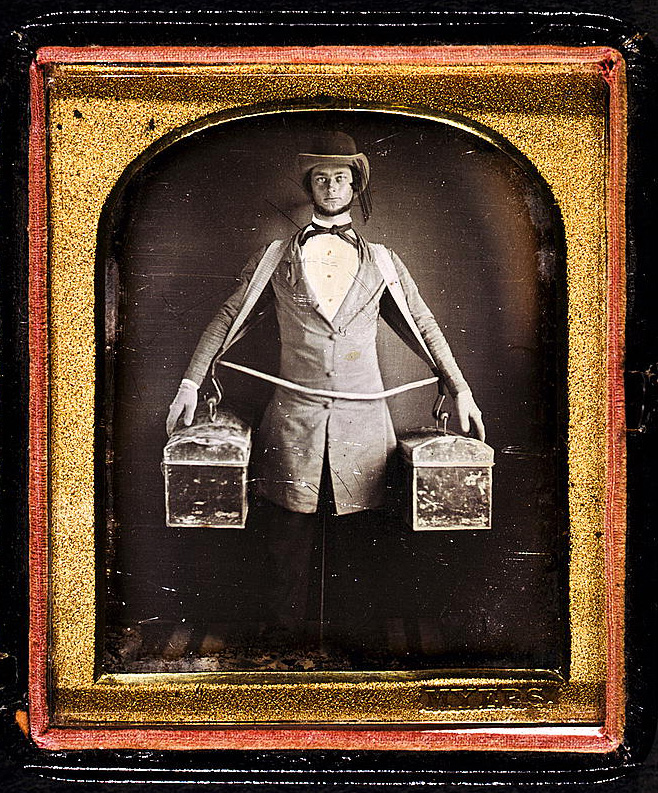
“Occupational portrait of a peddler, full-length, standing, facing front, with two bags held at his sides by a harness, neck brace visible between legs] Daguerreotype by Myers, between 1840 and 1860. https://blogs.loc.gov/teachers/2017/12/profiling-portraits-occupational-portraits-of-the-19th-century/”

Amongst the issues that have arisen from  poor research, about the original events at Hydesville, together with the general acceptance of books written years after the events, rather than searching the contemporary documents of that time,  is one   concerning the actual name of the peddler.

It appears that the name generally accepted is Charles B Rosna.but that name did not exist in any of the early records. Paul Gaunt has been following this up for many years and in this copy of Psypioneer http://www.iapsop.com/psypioneer/psypioneer_v1_n9_jan_2005.pdfdebates the issue of “What is known of the Hydesville Peddler”.

Then, late in 2011, I was completing a detailed review of all the electronic newspaper archives available in the US, UK, N.Z. and Aus to establish what was published in regards to Mysterious Knockings, Rappings, Spirit Manifestations and or the Fox Family over the period from 32st March 1848 to March 1852. In doing so I discovered credible evidence for a new surname. This was passed on to Paul and published in this edition of Psypioneer http://www.iapsop.com/psypioneer/psypioneer_v8_n1_jan_2012.pdf with some more thoughts about the issues relating to the Peddler from Paul.

The piece that I discovered nominated the name Rasme.

Taken from the Jeffersonian Republican December 13 1849

“From The New York Tribune, 1st December 1849 (the copy of the Tribune itself I have but in such poor condition it is not capable of reproduction)”

Knowing that the public mind, in various locations in Western New York, has been somewhat agitated on account of certain sounds, called by some “mysterious,” we shall offer no apology for making the following plain statement of facts in regard to our knowledge of the matter.

The sounds were first heard about two years since, and have not yet ceased, but seem to be spreading from one place to another and gradually claiming the attention of the public mind. When first heard, they were manifested by a simple hollow–sounding rap upon the floor of a house. This rapping was continued every night, for a long time and finally commenced in the daytime. It was at first entirely unintelligible to the inhabitant of the house.

At length a line girl said. ” Now do as 1 do,” and snapped her finger three times. She was answered by three raps. On repeating it she found that it invariably repeated the number she made herself. Another person said, “Now count ten,” and it was done. “Now count the age of “____ (one of the children.) It was done correctly. Another was tried with like success. As it began to display signs of intelligence the family became alarmed and the females all left the house at night.

The neighbors were called in but there was no cessation of the sounds. The excitement became intense, and at one time, it is said, nearly or quite 300 persons assembled to discover from whence the sounds proceeded. The house was thoroughly examined from garret to cellar, but, while the sounds continued, no one ever discovered the operator. At length it was discovered that every time a question was put that required an affirmative, a rap was heard for a negative no sound.

The question was put, “Are you a spirit?” The answer was by rapping three raps. By this means they found that it purported to be the spirit of a man. Many expedients were resorted to by which to find out the name of the man whose spirit was making these manifestations. At length a stranger asked ” If I will call the Alphabet, beginning with A. will you rap when 1 come to the first letter of his name.” The answer was affirmative.

He then commenced “A, B, C,” when he came to C, there was a rap. Again he went on, and it rapped at H, and in that way he spelled out the name of Charles Rasme.

This was a fascinating find from a very early source, written into the paper by George Willets, cousin of Issac Post and one of the 5 people who formed the circle to investigate the “Rochester Rappings” on a superficial look it seems to indicate that the issue of the peddlers name could be satisfactorily explained.

However, there is a caveat on this; the way the piece is written it makes it appear that it was a continuation of the communication started by the girls, and it ocurred while they were in the room. In the  E E Lewis booklet, produced from the original witness statements from all who had been present, neither Rosna nor Rasme is mentioned. Let us take a quote from Mr Dueslers statement about the name (the only reference to asking teh name in teh report and later on teh first night after Mrs Fox and the two girls had left ” I commenced with A, and asked if that was
the initial of its first name? there was no rapping. When I came to C, the
rapping was heard, and at no other letter in the alphabet. I then asked in the
same way, in regard to the initial of its sir-name; and when I asked if it was
B? the rapping commenced. We then tried all the other letters, but could
get no answer by the usual rapping. I then asked if we could find out the
whole name by reading over all the letters of the alphabet? and there was
no rapping.” So a C and a B no Charle no Rosna or Rasme.

Even if EE Lewis did preserve anonimity then how did George Willets know the name and get the facts concerning who asked the question wrong? None of the people who sat at the in the circle at Rochester had been present when the name was given at Hydesville. It is none because, most importantly, neither the two girls , nor their Mother were in the cottage at the time the name was given. They could have found out from conversations with those present, but surely that would  have been a different story to that presented to the newspaper above.

I am aware of a rumour that this name was actually either given at the Rochester Circle or at some other session after the Hydesville rappings had finished but have been unable to piece together any supprting evidence for this.

It is also important to note that at Lily Dale an artifact, claimed to be the peddlers pack, is on display. However, there is absolutely no documentary evidence about the discovery of this item. This contrasts with the excitement generated when the peddlers bones were, apparently, discovered in the foundations of the Fox Cottage.

Remember even the New York Times carried that story on November the 24th 1904

Image

When this event raised so much interest it does seem odd that there is no mention of the finding of the pack in any available literature i.e. books, magazines and newspapers. Indeed the first appearance of the pack is a mention in a book by Mercy Cadwallader called Hydesville in History and published in 1917 ( https://archive.org/stream/hydesvilleinhis00cadwgoog#page/n69/mode/2up ). This book has all the usual historical errors, the ages of the fox sisters are incorrect and the younger one asks Mr Splitfoot to do as I do whilst the actual contemporary record by EE Lewis (misquoted by Anne Leah Fox and repeated elsewhere) noted no mention of Splitfoot and it was the elder sister who asked the Spirit to do as I do. It also has an essay from a medium called PLOA Keeler called the Skeleton in the Fox Cottage which suddenly has the Pack appearing. Unfortunately Dr Keeler, although an influential figure in American Spiritualism was also controversial being caught out in fraud, which he admitted, by Harry Houdini and also by others in earlier days ( http://www.spiritualismlink.com/t2166-interesting-blogs-re-houdini ) so not the most reliable finder of the coveted pack.

Sadly there was no need for any of these distractions because it is the essence of the real story surrounding the Hydesville events which stands up to scrutiny. In particular the fact that the major discoveries were in the communication between the Spirit and the neighbours AFTER the two girls had left the cottage.

It is also interesting to see how little publicity this received in the Spiritualist Press I have found this article in Lily Dales own Sunflower paper.

Sunflower Body In Hydesville Cottage

However it does not make much of the find, does not mention the pack and focuses more on Spiritualism’s achievements without the Fox family. I guess feelings were still raw about the death blow to Spiritualism when the two girls admitted it was all a fraud. Even Margaretta’s subsequent retraction (but Katie never did) did not smooth things out. It’s worth reading the exonerating circumstances surrounding their reasons, in my article for the Spirit of PN (the Spirit that existed while Psychic News itself was out of production). It is also worth noting that whilst Leah became acceptable to Spiritualists, the movement turned their backs on Maggie & Kate as a result of their problems with Alcoholism. So when they died the movement hardly acknowledged their passing.

https://spiritofpn.wordpress.com/2011/04//05/the-unhappy-mediums

Now recent events put me onto the research to find the pack and it seems in doing it I may have lost the bones that were claimed to have been found, whilst still not resolving the issue of the pack. It did concern me that none of the reports were clear about what was found in the foundations and no detailed review was made to ensure the validity that this was a single headless skeleton; as claimed. The following comes after a visit to Mr Hyde who gathered the bones up and reported their finding.

Now courtesy of IAPSOP I have tracked the following alternate history

http://www.iapsop.com/archive/materials/occult_review/occult_review_v2_n7_jul_1905.pdf
P 52 CORRESPONDENCE
[THE following is a letter addressed to me by Dr. Veeder, of Lyons, N.Y., in answer to an enquiry which I set on foot relative to a statement which appeared in the London Press to the effect that discoveries had been made of human remains at the Fox Sisters’
House, at Hydesville. The statement was referred to on p. 160 of the April number of the Occult Review. The letter appears to minimise the importance of the alleged discoveries.-E d.] To the Editor of the Occult Review.

My dear Sir,-Your letter of May 2nd and the copy of the Occult Review have been received.
I have seen Mr. Hyde personally, and he showed me the bones, which he himself took from the cellar of the Fox Sisters’ House, of which he is the owner at present. These were the bones of the forearm of three arms, in part,-and some other odds and ends of bones, perhaps about a dozen in all. It looked as though they had been picked up by some boy or some one without a knowledge of anatomy and put into the cellar, a portion of the loose wall having been pushed or fallen over.

There does not seem to have been any attempt at verification, or any interest taken, they were simply dumped into a nail keg in the barn and left there. The whole thing seems trivial. It seems to me I am unfortunate, this is the way spiritualistic phenomena have invariably turned out so far as I have had any opportunity for observation.-Yours very truly, Ju n e 5, /905. M. A. Veeder.

In the April edition on P160 the Occult Review wrote “h y d e s v i l l e d is c o v e r ie s “An interesting piece of information, which I should be glad to have verified, comes to hand from Newark, NewYork* It is stated that the walls of the house of ‘the Fox Sisters at Hydesville, in this neighbourhood (where, it will be remembered, Modern Spiritualism was bom), have recently fallen in. They were found to be hollow, and within the space between was a headless skeleton. This is a curious commentary, if true, on Margaret Fox’s narrative, elucidated through ” spirit” rappings, that the agent of the phenomena in question was the headless victim of a murder who was buried beneath the house.”

Of course the American Society of Psychical Research then Wrote this http://www.iapsop.com/archive/materials/aspr_proceedings/aspr_journal_v3_1909.pdf
Editorial. 191
EDITORIAL.
A year or more ago a story went the rounds of the newspapers to the effect that a skeleton had been found on the site of the house in which the Fox sisters had lived, confirming the report that a man had been killed there and had afterward made himself manifest through the raps of the Fox sisters.
The story did not seem to merit any special attention, but as it has been mentioned in Mr. Carrington’s “Coming Science,’* with some credence, it may be well to call attention to a personal investigation of the incident by a physician of our acquaintance.
He was asked by the editor of the ” Occult Review1′ to look into the incident at the time. He reports to us that he found a number of bones there, but that there were only a few ribs with odds and ends of bones and among them a superabundance of some and a deficiency of others. Among them also were some chicken bones. There was nothing about the premises to indicate that they had been buried there, but might have been put there by boys in sport. He also reports that within a few days past he has learned that a certain person near the place had put the bones there as a practical joke and is now too much ashamed of it to confess it.
Whether there is any better foundation for these incidents than for the original story it is not possible to decide, but it is certain that the probabilities that there is anything more than a casual coincidence or than a trick played on the credulity of the defenders of the Fox sisters are very much shaded.

Sometimes research brings extra heartache because all to often a cherished belief is potentially proved false. Now the Doctor’s report could be false but somehow I would not like to bet on it. No bones then no pack I guess. But I note that in 2007 the following was said to Nickell of Csicop  “I examined the trunk at the Lily Dale museum, whose curator Ron Nagy (2006) conceded there was no real provenance for it nor any proof of its discovery in 1904. And the trunk’s condition appears far too good for its supposed half-century burial (figure 2).”

So the Peddler and his murderer remain enigmatic figures with no substantive physical evidence to prove their reality.

Therare many who have held the pack and psychometrised it (feeling the energy with their senses to try an read its history) who will still believ that the pack is real. However, it must be rememberd hundreds of people will have held this pack believing it is real and thereby entangling the energy of that belief into its fabric. So anyone holding the pack is going to sense that energy and is likely to believe in it.

Of course it still does not discredit the truth of Spiritualism, nor of the events at Hydesville., indeed Hydesville led on to the demonstration at Corinthian Hall, Rochester in 1849, where both the information and events which ocurred, through Margaretta’s mediumship, could not be disproved by 4 investigating committees.

Despite these issues I have experienced to much, myself, and read too much, from totally reliable sources, to deny that Spiritualim is based upon real communication.

Hydesville March 31st 1848

The events at Hydesville are key to the start of Modern Spiritualism but are sadly so mis-reported over history  that the actual facts have been misrepresented and distorted. It was not the youngest sister who asked the Spirit to do as I do and there was no mention of Mr Splitfoot. It was the eldest sister Anne Leah, not present at the time and only arriving in Hydesville about one month after the events on 31st March, who embellished the story. Firstly to Robert Dale Owen, who would then add them to his book Footfalls on the Boundary to start the error and then in her book the Missing Link.  Leahs work was then the basis of Hydesville In History produced by Mercy Cadwallader in 1917. This seems to be used as the key reference works for the National Association of Spiritualists in the USA and theuir educational Institute The Morris Pratt Insitute.So teh errors perpetuate and spread.

In addition the girls left the house early and it was a neighbour Mr Duesler who oversaw most of the communication which took place. Thankfully one EE Lewis, a lawyer turned journalist came along and within 11 days took detailed testimonies from all the participants, these were gathered into a short book published by the end of April 1848. Sadly lazy work from researchers meant no one seemed to go back to Lewis’s work to note Anne Leahs mis-quotations until around the year 2000 when Psypioneer published a copy of the pamphlet. The real history is well worth reading, so here are two links to it, one in Psypioneer http://www.iapsop.com/psypioneer/psypioneer_v1_n12_apr_2005.pdf   and one from Marc Demarest and his research group, including Pat Deveney, who are restoring so much original material to us, http://www.iapsop.com/archive/materials/lewis_noises/

Background _ Where is Hydesville and why did it develop.

hydesv10 the areaWell if we are to start a blog about Spiritualism it does seem important to place some context to the historical and social elements that preceded the events in Hydesville on 31st March 1848.
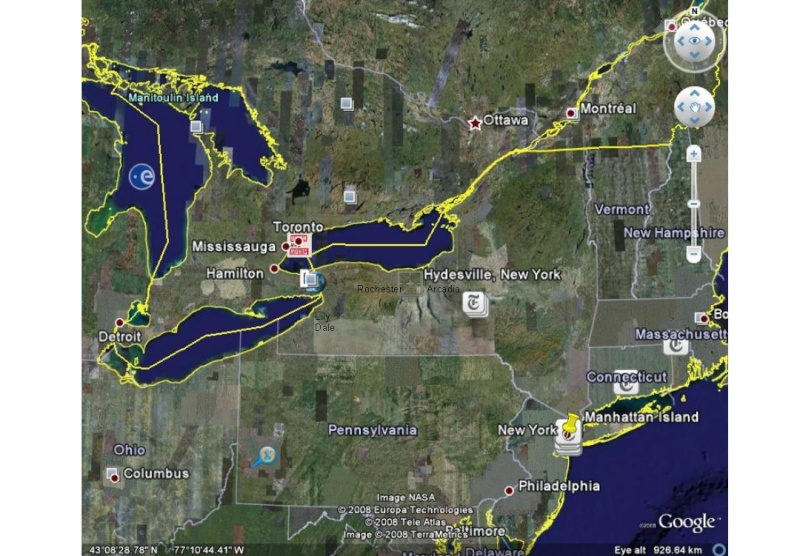
One of the first things which may be of interest to people is the actual geographic location where the events took place, whilst Americans may know others may be as geographically challenged as I was. Given the importance of the second act in Rochester, November 1849, the map chosen covers the entire area and shows in faint letter the site of the famous Spiritualist Camp at Lily Dale.

Now Modern Spiritualism was founded from the events which occurred over several days commencing on the evening of March 31st 1848, at the Cottage where the Fox family lived in Hydesville New York State. This whole area was only developed because of the newly built Erie Canal which was developed to open up the trade in wheat by linking the great lakes area to the City of New York. This one development was to create New York as the most important City and Sea Port on the East Coast of America. For interest the history of the Erie Canal can be found here http://www.canals.ny.gov/history/history.html . This will also show just how much this affected the economic and social development of the area

Background – Before the American War of Independence

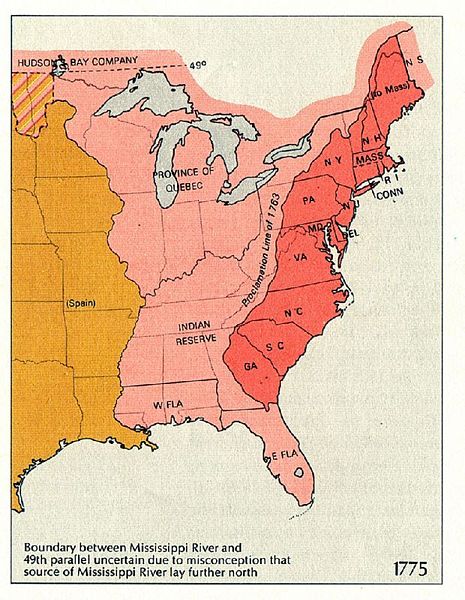
For interest after the wars in Canada, which resulted in the capture of Quebec from the French, there was a peace treaty drawn up in 1763 in Paris. At this not only were the new British Territories in Canada and on the Eastern Seaboard of America defined but the Indian Nations were protected by reserving the entire area West of the Appalachian Mountains. At that time the whole area where the Fox Cottage came to stand was in the lands of the Iroquois Nations a confederacy which from 1702 comprised 6 Nations.

This land was very fertile, attractive to settlers and the restrictions placed upon settlements in the Indian territories were one of the contributory causes to the ensuing war, because, strangely enough the British resisted any breach of this 1763 Proclomation. However, the support of the Iroquois Nations to the British cause, in the American War of Independence changed the situation dramatically. After the attritional wars of independence and the Indian wars the settlers moved in to  take over these lands. It may be of interest that one of the leaders of the Iroquois Confedarcy was educated at Ofxford Unniversity. Many of the  confederacy were re located by the British Government to Canada after Independence, to avoid reprisals.