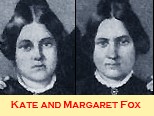
March 31st 2023 will be the 175th anniversary of the beginnings of Modern Spiritualism. While researching this historic event I came across an article, The Fox Sisters: Some Unsolved Problems, published June 24, 1943, in ‘Light’, the weekly journal of Spiritualism.
The article raised several issues. First, that there appeared to be no properly researched history of the Fox family. Attempts to establish where the Fox family had come from, or where the girls were born, had apparently failed. This seemed a great failure given their importance in initiating Spirit Communication. Second, there was uncertainty about the ages of the girls at the time of the events at Hydesville, New York County. Margaretta may have been 15, 14, 13 or 12, and Kate 12, 11, or 9.
The third issue of concern was whether there was any validity to Maggie and Kate’s confessions that what had occurred at Hydesville and afterwards, had “been humbuggery from first to last” and “an absolute falsehood”. It was noted, these admissions led to the publication in 1888 of “A Death Blow to Spiritualism” by Reuben Briggs Davenport. While arguing that Spiritualism did not stand or fall on the work of the Fox Sisters, the writer thought that a true record would be of benefit.
When examining the importance of the Fox Sisters to the Spiritualist movement, there is little doubt that it was their work in the first three years that helped fuel the interest of many, as the reports of events in Rochester and then New York spread through the country. The interest taken in the girls by Horace Greeley, editor of the New York Tribune, meant many people attended séances, including those in a position of influence, who left impressed by the information they had received. After the Fox sisters left New York, the New York Tribune of September 30th 1850 carried a report praising “their integrity and good faith”.
Although the Fox sisters were friendly with many who became the founders of the Spiritualist movement, Maggie and Kate largely remained distanced from the actual events that helped promote its development. Indeed, the personal circumstances of each of the sisters were to see them take very different pathways in life, and ultimately result in the breakdown of their relationship with the family, especially with Ann Leah, their eldest sister, and with Spiritualism.
In 1849, Kate Fox spent time in the home of Eliab Wilkinson Capron in Auburn and did not take part in the first public demonstration of mediumship, with its subsequent investigation, at Rochester in November of that year. In 1851, Greeley persuaded the Fox’s to let Kate go to school, to gain a proper education. She spent some months at his residence, until the living conditions with Mrs. Greeley, became intolerable.
On returning home Kate resumed holding séances and doing readings. Perhaps, not surprisingly, given the way her life developed, Kate was often described as a person who seldom embraced life joyously. As far as possible she worked away from her sister Ann Leah Fox. In 1852 Kate was to be found in New York working giving readings at the newly founded organisation the Society for the Diffusion of Spiritualist Knowledge. This association lasted two years and published its own newspaper the Christian Spiritualist which can be found on line at http://www.iapsop.com/archive/materials/christian_spiritualist/
Towards the end of 1852, Maggie Fox met Elisha Kane, an Arctic Explorer. He became enamored with her but not with Spiritualism which he felt was an improper way of life. Throughout 1853 he worked to convince her that if she was to marry him she needed to give up the Spirits and take up schooling. Finally, in the latter half of 1853, she stopped working as a medium, and moving away from her family, commenced a period of private schooling, arranged by Kane.
Maggie claimed that she and Elisha Kane were married in secret in October 1856. Despite moving back with her family while he was away on his travels, to honour his wishes, she did not return to spirit work. Sadly, the 37 year old Kane died in Havana on Feb 16, 1857. After his passing, Kane’s family refused to provide for Maggie denying her alleged marriage to their son. Despite financial hardship, Maggie did not return to spirit work, but spent years fighting Kane’s family over money she believed Kane had intended she receive. During this period, with its levels of distress, bouts of anger and depression, Maggie began to suffer the effects of alcoholism, a problem that continued throughout the rest of her life. Kate, too, would soon suffer from the same condition.
In November 1858 Ann Leah married the wealthy Spiritualist, Daniel Underhill, entering a very different, more affluent lifestyle with many influential friends. This allowed her to remain more intimately involved with Spiritualism. Emma Hardinge Britten’s auto-biography, published in 1900, after her death, highlights Ann Leah’s friendship with Robert Dale Owen and Emma. Indeed, this book states that it was at a séance with Ann Leah and Robert Dale Owen, around 1862, that Robert Owen came through to Emma impressing her with the Ten Spiritual Laws and Ten Spiritual Commandments, which were included in the first Lyceum Manual.
In December 1864, friends of Maggie and Kate, discovered the state of their dependence upon alcohol and it was arranged that the sisters go into the treatment centre of a George Taylor, with the costs to be paid for by Ann Leah and Daniel Underhill. However, the death of their father John Fox on Jan 5th 1865, delayed matters. Subsequently Katy agreed to go ahead with treatment, but Maggie refused help.
On August 3rd 1865, Mrs Fox passed away, once again leaving Maggie and Kate to grieve. Maggie, disillusioned with the continued mistreatment of her by Kane’s family released The Love Life of Doctor Kane, a book based on his letters to her. If Maggie had hoped the book would end her financial worries she was sadly disappointed and was finally driven back to working as a medium. Throughout this period her relationship with Ann Leah continued to deteriorate. They were rarely on speaking terms, and the rift between them would ultimately prove permanent.
Despite receiving treatment, Kate was too easily drawn back to alcohol by her sister, so a subterfuge was worked out, whereby she was invited to London. The trip proved successful, and her mediumship moved to a new level, proving successful under strict test conditions, particularly for Sir William Crookes. On a personal level, she also benefitted, marrying the Barrister Henry Jencken on 14th December 1872, and forming a very happy partnership which saw the birth of two children. (you can find the research by Crookes here just search the pdf for Fox http://chem125-oyc.webspace.yale.edu/125/history99/8Occult/CrookesPsychic.pdf )
Sadly on November 26th 1881, Jencken died leaving his affairs in a state that made it difficult for Kate. She finally managed her return to New York in 1885. This coincided with the release of Ann Leah’s book, The Missing Link in Spiritualism, which added to the disharmony between the sisters. Sadly, the return also saw a progressive relapse into alcoholism for Maggie and Katie.
It is these disparate events that have led to a fractured account of the real history of the Fox Family. Many accounts have softened the truth, others have changed it in various ways. Probably, given the sad way the lives of Katie and Margaret played out, it is not surprising their stories have been inadequately reported.
Particularly relevant was the way that Ann Leah Fox Underhill embellished her accounts of Spiritualism’s beginnings. We see this, both in her 1885 book, and in the story she passed on to Dale Owen, recorded in Footfalls on the Boundary of Another World,published in 1860. In these books, the two young girls ages change, and it is Kate, not Margaret, who asks “Mr. Split-foot” to do as I do. In Mrs. Fox’s initial account of events recorded just 4 days after the fateful night communication with the spirit world began, and published a few weeks later by E. E. Lewis in the pamphlet A Report of the Mysterious Noises, Heard in the House of Mr. John D. Fox, no mention is made of the phrase ‘Mr. Split-foot, Margaret Fox’s older daughter, Maggie, is described as having said ‘do as I do,’ and the girls are described as being in their 15th year, and about 12.
How, and why, the ‘Mr. Split-foot’ aspect of the story came to be incorporated into later records is still unclear. That the ages of girls as stated by Mrs. Fox in April 1848 should subsequently become so uncertain, can, however, largely be attributed to the deliberate obscuration of the truth on the part of Maggie, Kate, and Ann Leah, though why they did so remains unclear. A copy of the Lewis Report, can be found at psypioneer.iapsop.com/psypioneer_v1_n12_apr_2005.pdf and research into the ages of the Fox sisters, by Lis Warwood, at http://psypioneer.iapsop.com/psypioneer_v5_n9_sep_2009.pdf
As for Maggie and Kate’s confessions, at the time both sisters were in a sorry state, short of money, and drinking excessively again. It is almost certain that Maggie received money to confess. An Oct 12 1888, Chicago Tribune article revealed Kate was furious with Ann Leah and her Spiritualist friends. She believed they had her two children taken away by the Society for the Prevention of Cruelty to Children, because her drinking made her incapable of looking after them. It is no wonder that she then turned upon her perceived enemies.
Subsequently, Maggie recanted her confession, indeed, when she died on March 9th 1893, the records show that raps were occurring all around her bedchamber. Kate had died on July 2nd 1892. Largely shunned and ignored by the Spiritualist movement, their unhappy and troubled lives had finally come to an end.
Oh yes, on November 24th, 1904, The New York Times reported the finding of a headless skeleton in the foundations of the Fox Cottage, thus apparently corroborating the story of the rappings, However, who the pedlar was, what happened to his bones, and what else, if anything was found to substantiate his existence, is another story.
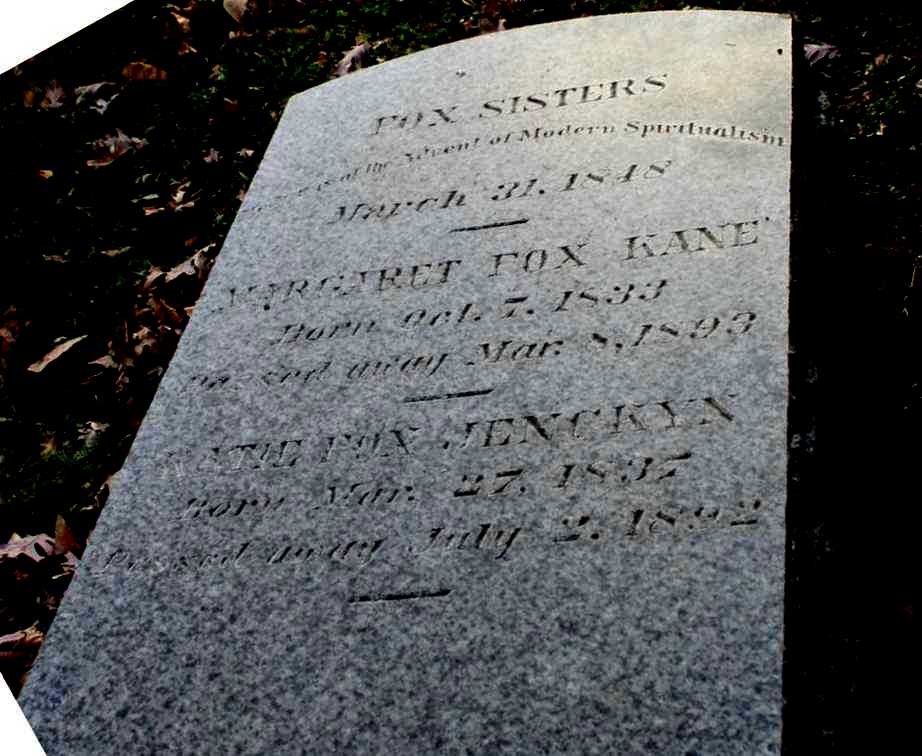
As a final point the headstone shown below, paid for by Margaretta’s close friend Titus Merritt, he obtained the birth dates from Margaretta just before her death. Naturally these matched the ages that were given in the EE Lewis report at the time of the Hydesville rapping’s. These were also the dates that their Mother repeated on several occasions. So despite her, and Kate’s lifetime of becoming younger at each census Margaretta resumed her correct age just before she passed to Spirit.
Sadly although monies were collected to restore the old headstone, a new one was effectively produced, using different birth dates. These accorded with the view of the person who arranged the renovation who felt she had got different information from relatives. So, visitors to the headstone will never know about the change because it was never commented upon at the time. To me the original information was correct as the family would have become confused by the numerous age changes the sisters insisted upon over life.I suspect the answer may lie in the letters exchanged between Kate and Margaretta and Amy Post but they do not appear in those digitised so far.
©Lis & Jim Warwood
 The Philosophy and History of Spiritualism